
Table of Contents
Roof water leakage is one of the most damaging — and most common — problems in Indian homes. Flat RCC slab roofs, which cover the vast majority of Indian apartments and independent houses, are particularly vulnerable. Over time, cracks form in the slab, waterproofing layers degrade, and the monsoon does the rest. Left unaddressed, a roof leak doesn’t stay a roof problem — it becomes a ceiling problem, a wall problem, a mould problem, and eventually a structural problem. This guide covers 7 proven solutions for roof water leakage in Indian homes, with real cost estimates, product recommendations, and a clear guide on when to DIY and when to call a professional.
Warning Signs: How to Identify Roof Water Leakage
Yellow-brown ceiling stains and peeling paint — the clearest early warning signs of roof slab leakage
Catch it early and a roof leak costs ₹5,000–20,000 to fix. Miss it for a monsoon season and you’re looking at ₹50,000–2,00,000 in structural repairs. Watch for:
- Damp patches or yellow-brown stains on the ceiling — especially after rain, the clearest indicator of slab leakage
- Peeling or bubbling ceiling paint — water trapped under the paint layer causes it to lift and blister
- Musty smell in rooms below the terrace — moisture in the slab creates mould with a distinctive earthy odour
- White chalky deposits (efflorescence) on walls — water carrying salts through the concrete
- Rust stains below slab joints — water reaching the steel reinforcement — a serious structural warning sign
- Cracking plaster on the ceiling — the slab expanding and contracting from water absorption
Rule of thumb: Staining only after rain = roof slab. Staining year-round = check for plumbing leaks from the floor above first.
Common Causes of Roof Water Leakage in India
Hairline cracks in RCC slab — the most common cause of roof leakage in Indian homes
- Failed or absent waterproofing — most pre-2000 buildings were built without proper waterproofing membranes. Even newer waterproofing degrades after 10–15 years
- Cracks in the RCC slab — concrete naturally develops hairline cracks from thermal expansion. In Indian climates with extreme temperature ranges, this happens faster
- Damaged or blocked expansion joints — the gaps between slab sections fill with debris, water pools, and seeps through
- Parapet wall failures — water accumulates at the junction between the parapet and the slab, a classic weak point
- Overhead water tank leaks — a leaking tank on the terrace is frequently misdiagnosed as a slab leak
- Inadequate drainage slope — flat terraces need a minimum 1:100 slope. Without it, water ponds and finds any crack to enter
- Tree root damage — in older buildings, roots from nearby trees can penetrate and widen slab cracks
7 Solutions for Roof Water Leakage — With Costs
Cementitious waterproofing being applied on RCC terrace — the most affordable entry-level solution
1. Cementitious Waterproofing — ₹40–70/sqft
A cement-based waterproofing compound mixed with polymers and applied directly to the slab surface. Products like Dr. Fixit Powder Waterproof or Fosroc Brushbond are the most common in India.
- Best for: Mild seepage, new construction, terraces with minor cracking
- Cost: ₹40–70/sqft including labour
- Durability: 5–8 years
- Limitation: Not suitable for active cracks or areas with significant structural movement
- DIY possible: Yes, with care
Polyurethane liquid membrane being roller-applied on Indian terrace — the best all-round solution for most homes
2. Polyurethane (PU) Liquid Waterproofing — ₹70–120/sqft
A liquid-applied membrane that cures to form a seamless, flexible waterproof layer. Bonds to the concrete and accommodates minor cracking and movement. Products include Dr. Fixit Pidifin 2K, Fosroc Proofex, and SikaTop Seal.
- Best for: Most Indian flat roof slabs — good balance of cost, performance, and durability
- Cost: ₹70–120/sqft including labour
- Durability: 8–12 years
- DIY: No — professional application recommended for full warranty
Torch-on bituminous membrane waterproofing — heavy duty solution for large terraces and severe seepage
3. Bituminous Membrane Waterproofing — ₹90–150/sqft
A thick bitumen-based sheet membrane, either torch-applied (hot) or self-adhesive (cold). Creates a heavy-duty waterproof barrier. Widely used in commercial buildings and large terraces.
- Best for: Heavy seepage, large terrace areas, commercial buildings, high foot traffic
- Cost: ₹90–150/sqft including labour
- Durability: 10–15 years
- Limitation: Requires professional installation — torch-applied membranes need skilled applicators
Crystalline waterproofing penetrates concrete and forms crystals inside — effectively permanent protection
4. Crystalline Waterproofing — ₹80–140/sqft
A chemical treatment that penetrates concrete and forms crystals inside the slab itself, permanently blocking water pathways. Unlike surface coatings, it becomes part of the concrete. Products include Xypex, Kryton, and Penetron.
- Best for: Basement walls, water tanks, foundation slabs, severe seepage
- Cost: ₹80–140/sqft including labour
- Durability: Effectively permanent — crystals re-activate when water is present
- Best choice when: The source of water cannot be fully eliminated
Injection grouting — chemical injected under pressure directly into the crack, expanding to fill it completely
5. Injection Grouting — ₹500–2,000/linear metre
A chemical (polyurethane or epoxy) is injected under pressure directly into cracks in the slab or wall. It expands to fill the crack completely from inside. Highly effective for active leaks — water actually helps the chemical expand.
- Best for: Active leaks through visible cracks, basement walls, slab joints
- Cost: ₹500–2,000 per linear metre of crack
- Durability: 10–20 years for the treated crack
- Note: Targeted repair — usually combined with a surface membrane for full protection
Brick Bat Coba (BBC) relaying — traditional Indian waterproofing system being restored on older building terrace
6. Terrace Brick Bat Coba (BBC) Repair — ₹60–100/sqft
The traditional Indian waterproofing system — broken brick pieces (bat) set in cement mortar with a lime plaster finish, creating an insulating and waterproofing layer. Many Indian buildings have existing BBC that has simply failed and needs replacement.
- Best for: Replacing failed traditional BBC systems in older buildings
- Cost: ₹60–100/sqft for demolition and relaying, plus new membrane underneath
- Durability: 10–15 years with a proper membrane below
- Important: BBC alone without a waterproofing membrane underneath is no longer recommended
Silicone waterproof coating on external walls — suitable for prevention and minor surface seepage
7. Silicone or Acrylic Waterproof Coating — ₹20–45/sqft
A surface-applied liquid coating that repels water. Products like Asian Paints Damp Block, Berger WeatherCoat, and Dr. Fixit Raincoat fall into this category. The simplest and cheapest option.
- Best for: External walls, minor surface seepage, preventive treatment on new buildings
- Cost: ₹20–45/sqft
- Durability: 3–5 years
- Limitation: Does not address structural cracks or active leaks — a surface coating on a cracked slab will fail within one monsoon. Suitable for prevention, not cure.
- DIY possible: Yes
Solution Comparison Table
| Solution | Cost (₹/sqft) | Durability | Best For | DIY? |
|---|---|---|---|---|
| Cementitious | ₹40–70 | 5–8 years | Mild seepage, new construction | Yes |
| Silicone/Acrylic Coating | ₹20–45 | 3–5 years | Prevention, external walls | Yes |
| BBC Repair | ₹60–100 | 10–15 years | Older buildings, BBC replacement | No |
| Crystalline | ₹80–140 | Permanent | Basement, severe seepage | No |
| Polyurethane (PU) | ₹70–120 | 8–12 years | Most terraces — best all-rounder | No |
| Bituminous Membrane | ₹90–150 | 10–15 years | Heavy seepage, large areas | No |
| Injection Grouting | ₹500–2,000/m | 10–20 years | Active cracks, point leaks | No |
Waterproofing Cost by Home Size (2026)
| Home Type | Terrace Area | Cementitious (₹40–70) | PU Membrane (₹70–120) | Bituminous (₹90–150) |
|---|---|---|---|---|
| 1BHK flat | 150–250 sqft | ₹6,000–17,500 | ₹10,500–30,000 | ₹13,500–37,500 |
| 2BHK flat | 250–400 sqft | ₹10,000–28,000 | ₹17,500–48,000 | ₹22,500–60,000 |
| 3BHK flat | 350–600 sqft | ₹14,000–42,000 | ₹24,500–72,000 | ₹31,500–90,000 |
| Independent house | 600–1,200 sqft | ₹24,000–84,000 | ₹42,000–1,44,000 | ₹54,000–1,80,000 |
Note: Mumbai and Bengaluru run 15–20% higher. Hyderabad and Pune are broadly in line. Delhi NCR varies significantly by contractor.
DIY vs Professional: Which Situations Need an Expert?
| Situation | DIY or Professional? | Why |
|---|---|---|
| Single damp patch after first monsoon | DIY — cementitious or acrylic coating | Likely minor surface issue, low risk |
| Multiple stains across ceiling | Professional assessment first | Multiple entry points need mapping before treatment |
| Active dripping during rain | Professional — injection grouting likely needed | Active crack requires specialist chemical injection |
| Rust stains on ceiling | Structural engineer + professional waterproofer | Reinforcement corrosion is a structural issue |
| Entire terrace waterproofing | Professional | PU or bituminous membrane needs proper application for warranty |
| Preventive treatment on new terrace | DIY possible | Low stakes — surface treatment acceptable |
Monsoon Preparation: When to Get Waterproofing Done
March to May is the ideal window — dry surfaces, proper curing time, contractors available before peak demand
The best time to waterproof your roof is March to May — before the monsoon arrives.
- March–May: Ideal — dry weather, surfaces cure properly, contractors available before peak demand
- June–September (monsoon): Full waterproofing cannot be done on wet surfaces. Emergency injection grouting for active leaks is possible, but full treatment must wait
- October–November: Good — post-monsoon, surfaces drying, second-best window
- December–February: Possible in most of India, but cold can slow curing in northern cities
If you’re reading this during monsoon with active leaks: emergency injection grouting can stop an active leak immediately. Call AapkaPainter for a same-day assessment in Bengaluru, Mumbai, Hyderabad, Pune, and Delhi NCR.
Get Your Roof Waterproofed by AapkaPainter
AapkaPainter provides professional waterproofing services across Bengaluru, Mumbai, Hyderabad, Pune, Chennai, Delhi, and Noida. Our waterproofing teams are trained, background-verified, and use Dr. Fixit, Fosroc, and Sika approved products with a service warranty.
👉 Get a free waterproofing assessment from AapkaPainter →
Frequently Asked Questions
What is the best permanent solution for roof water leakage?
For most Indian flat RCC roofs, polyurethane (PU) liquid membrane is the best all-round permanent solution — flexible, seamless, handles minor crack movement, lasts 8–12 years. For severe or active leaks, injection grouting to seal the crack followed by a PU membrane is the most effective combination. Crystalline waterproofing is the most durable option (effectively permanent) but costs more and requires specialist application.
How do I stop water leakage from my concrete roof slab?
First identify whether it’s an active crack (water visible during rain) or generalised seepage (damp patches that appear and dry). Active cracks need injection grouting first, then a waterproof membrane. Generalised seepage from an aging slab can usually be addressed with a PU or bituminous membrane across the full terrace surface. Never apply a surface coating over active cracks — it will fail within one monsoon.
What chemical stops water leakage from the roof?
The most effective chemicals for roof waterproofing in India are polyurethane (PU) liquid membranes, bituminous compounds, and crystalline waterproofing agents. For crack injection: polyurethane foam grout (expands on contact with water) and epoxy resins. Products from Dr. Fixit (Pidifin 2K), Fosroc (Proofex), and Sika are widely used and available across India.
How much does roof waterproofing cost in India in 2026?
Roof waterproofing costs ₹40–150/sqft depending on method. For a typical 2BHK terrace (250–400 sqft): ₹10,000–60,000 total. Mumbai and Bengaluru run 15–20% higher.
Can I waterproof my roof myself?
Preventive surface coatings and cementitious waterproofing can be DIY’d with care. For serious seepage, PU membranes, bituminous sheets, and injection grouting require professional application — incorrect application voids product warranty and often makes the problem worse by trapping water.
How long does roof waterproofing last?
Silicone/acrylic: 3–5 years. Cementitious: 5–8 years. PU membranes: 8–12 years. Bituminous membranes: 10–15 years. Crystalline: effectively permanent. All methods last longer with proper surface preparation — poor prep is the #1 cause of early waterproofing failure.
Why does my roof leak only during heavy rain?
Light rain doesn’t generate enough hydrostatic pressure to push water through minor cracks. Heavy rain creates more pooling on the terrace, increasing pressure and forcing water through cracks that stay dry in light rain. This is a sign waterproofing is failing — not fixing itself during dry weather.
What should I do if water is actively dripping from my ceiling right now?
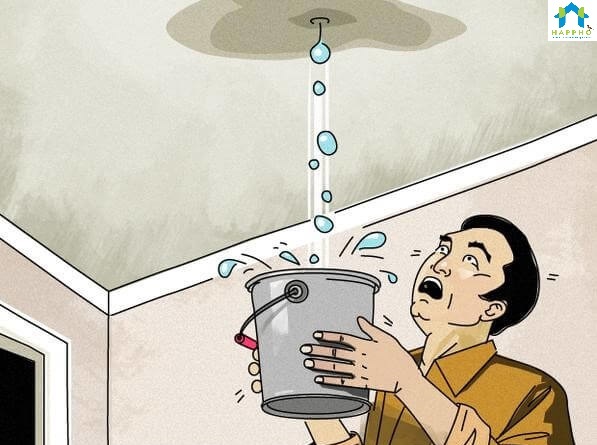
Place buckets immediately. If electrical fittings are nearby, turn off that circuit at the breaker. Do not attempt repair during active rain — surfaces must be dry. Once rain stops, call a professional waterproofer. Injection grouting can be done within 24–48 hours of the surface drying. Do not ignore — each monsoon cycle without repair worsens structural damage significantly.
How do I know if my building society is responsible for waterproofing my terrace?
In most Indian housing societies, the terrace slab is common property — the society is responsible for waterproofing, not individual flat owners. If leakage is coming through the slab to your flat, raise a formal written complaint with the society committee. If they fail to act, you can approach the local cooperative housing court. Keep documentation — photos with dates, written communications.