
Table of Contents
Roller Painting vs Spray Painting: Which Is Better for Indian Homes? Cost, Quality & Complete Guide (2026)
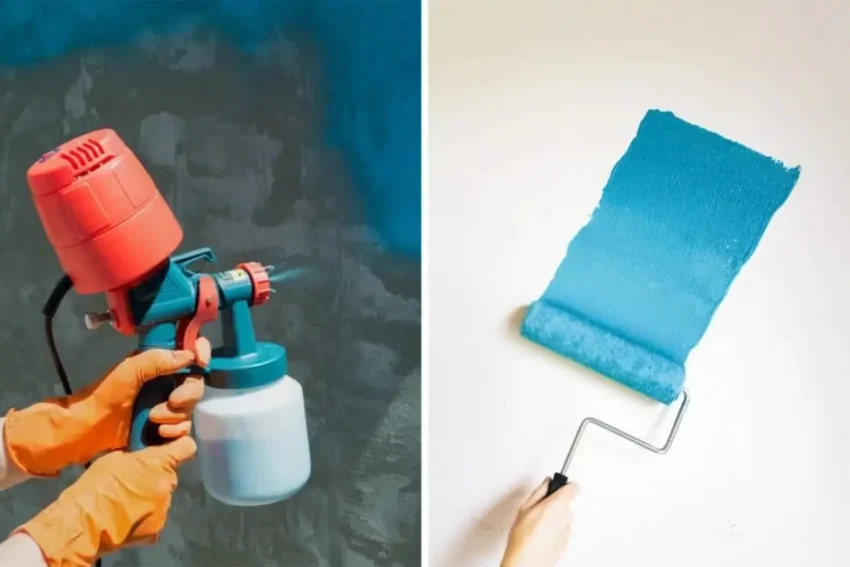
Roller painting — fast, even coverage, ideal for large flat wall surfaces in Indian homes
When you hire a painter for your Indian home, one of the key choices that affects both cost and finish quality is the application method: roller painting or spray painting. Both techniques are widely used in India, but they suit very different situations. This 2026 guide breaks down the complete comparison — finish quality, speed, cost, waste, suitability for Indian homes, and when to use which method — so you can make the right choice for your next painting project.
The short answer: for most Indian interior painting jobs (walls and ceilings of homes and apartments), roller painting is the better choice. Spray painting is superior for large exterior facades, metal gates, furniture, and situations where an ultra-smooth factory finish is required. But the full picture involves more nuance — read on.
Roller Painting: How It Works
Roller painting uses a cylindrical foam or fibre roller loaded with paint and rolled across the wall surface. It is the standard painting technique used in 90%+ of Indian home painting projects. Rollers come in different nap (pile) thicknesses — short nap (6mm) for smooth walls, medium nap (12mm) for textured or slightly rough surfaces, and long nap (18mm+) for heavily textured surfaces. Professional painters use extension poles to reach ceilings and upper wall sections without scaffolding in standard-height rooms.
Spray Painting: How It Works
Spray painting atomises paint into fine droplets using compressed air (conventional spray) or a high-pressure pump (airless spray), which are then directed at the surface through a nozzle. Airless spray painting is the dominant professional spray technique in India — it operates at high pressure (2,000–3,500 PSI) and can apply paint much faster than rollers on large flat surfaces. Spray painting requires extensive masking and covering of all surfaces not being painted (floors, furniture, fixtures, doors, windows) — which adds significant setup time and cost.
Roller vs Spray Painting: Full Comparison
| Parameter | Roller Painting | Spray Painting |
|---|---|---|
| Finish quality (smooth walls) | Very good — slight texture from roller | Superior — glass-smooth when done correctly |
| Finish quality (textured walls) | Excellent — roller gets into texture recesses | Good — may miss deep recesses |
| Speed (large flat surfaces) | Moderate | Much faster — 3–5× speed of roller |
| Setup time | Minimal — just protection of edges | High — full room masking required |
| Paint waste | Very low (5–8%) | Higher (15–30% overspray) |
| Cost (labour) | Lower | Higher (equipment + setup + masking time) |
| Edge control | Excellent — precise with brush cuts | Harder — overspray risk near edges |
| Suitability for occupied homes | Excellent — minimal disruption | Challenging — strong fumes, extensive masking |
| Suitability for new construction | Good | Excellent — no masking needed for bare walls |
| Best for | Interior walls, regular repainting | Large exteriors, metal surfaces, furniture |
Spray painting — faster on large exteriors and textured surfaces but requires masking and skill
Cost Comparison: Roller vs Spray Painting in India
| Application Method | Labour Cost (₹/sq ft) | Paint Usage (relative) | Total Painting Cost (₹/sq ft, all-in) |
|---|---|---|---|
| Roller — interior standard emulsion | ₹7–12 | Standard | ₹18–35 |
| Roller — interior premium (Royale) | ₹8–14 | Standard | ₹28–45 |
| Airless spray — interior | ₹10–18 | +15–25% extra paint (overspray) | ₹25–50 |
| Airless spray — exterior large facade | ₹8–14 | +15–20% extra paint | ₹20–42 |
| Conventional spray — metal/furniture | ₹12–22 | High (speciality paints) | ₹40–90 (varies widely) |
When to Use Roller Painting for Indian Homes
Roller painting is the right choice for the vast majority of Indian home painting situations. Use rollers for: all interior wall and ceiling painting in occupied homes; textured wall surfaces where rollers reach into the texture recesses better than spray nozzles; repainting projects where furniture is present and full masking is impractical; homes in Indian cities where ventilation is limited and spray fumes would be problematic; any job where precise edge work around doors, windows, and ceiling-wall junctions is required; and all wall putty application (which is always done by hand/trowel, never sprayed).
Roller painting gives professional painters excellent control over paint film thickness, allowing them to apply consistent 2-coat coverage without runs or sags. A good painter with a quality roller and Asian Paints Royale Luxury Emulsion will produce a finish that is essentially indistinguishable from a sprayed wall when viewed at normal room distances.
When to Use Spray Painting for Indian Homes
Spray painting is the superior choice in specific situations: new construction where walls are bare and no masking is needed; large exterior building facades (100+ sq ft of uninterrupted flat surface) where spray speed advantages outweigh setup time; metal gates, grilles, railings, and doors where a factory-smooth finish is desired; furniture refinishing and lacquering where roller marks would be visible; and popcorn or very heavily textured ceiling finishes where a spray gun deposits material more uniformly than a roller.
In Indian apartment complexes, spray painting is commonly used by developers during new construction for rapid application on bare concrete before any fittings are installed. For homeowner repaints in furnished apartments, spray painting is rarely the best choice due to the masking overhead and fume issues.
Is a Paint Sprayer Better Than a Roller?
For the average Indian homeowner repainting their flat or house: No, a paint sprayer is generally not better than a roller. The roller’s advantages in this context — ease of use, low paint waste, precise edge control, no fume issues, and lower overall cost — outweigh the sprayer’s superior finish quality, which is only appreciably better on new, perfectly smooth walls. When your painter recommends spray painting for an interior repaint of an occupied home, ask them for a detailed justification — in most cases, roller painting by a skilled painter will deliver equivalent visible results.
For exterior facades, large commercial spaces, or new construction: Yes, an airless sprayer is often the better tool — it is dramatically faster than a roller on large, uninterrupted surfaces, and the finish quality is excellent on properly prepared flat exterior walls.
Room-by-Room Recommendation: Roller or Spray?
| Area | Recommended Method | Reason |
|---|---|---|
| Bedroom walls | Roller | Better edge control; no fume issues; textured walls common |
| Living room walls | Roller | Furniture present; precise colour blocking needed |
| Kitchen walls | Roller | Complex geometry with cabinets; roller gives better edge finish |
| Bathroom walls | Roller | Small confined space; fumes from spray problematic |
| Ceiling | Roller (with extension pole) | Even coverage; spray overspray is hard to control on ceilings |
| Exterior facade (large) | Airless spray | Speed advantage huge on large flat areas; no furniture to protect |
| Metal gate / grille | Spray | Smooth finish required; roller leaves marks on metal |
| Wooden door/furniture | Spray (or brush) | Factory-smooth finish; roller texture visible on wood |
Frequently Asked Questions: Roller vs Spray Painting
Is roller painting or spray painting better for home interiors?
For home interior walls in India, roller painting is better in almost every practical scenario — lower cost, better edge control, less masking required, no fume concerns, and very good finish quality. Spray painting is only meaningfully superior for large, perfectly smooth new walls where a glass-smooth finish is the priority and the space is empty of furniture and fittings.
Does spray painting use more paint than roller painting?
Yes — spray painting typically wastes 15–30% of paint to overspray (airborne paint that misses the surface and settles on covered areas or is exhausted). Roller painting waste is just 5–8%. Over a large job, this extra paint consumption adds meaningful cost, partially offsetting spray painting’s labour speed advantage. Airless sprayers are more efficient than conventional air spray, but still produce more overspray than rollers.
How long does spray painting take vs roller painting?
For raw application speed on open walls, an airless spray painter can cover 5–8× more sq ft per hour than a roller painter. However, spray painting requires 3–4 hours of masking setup before painting begins (covering all surfaces, furniture, fixtures) and 2–3 hours of unmasking after. For a standard 2 BHK interior, roller painting by a team of 2 painters takes 4–6 days; spray painting by the same team might take 2–3 days on the walls but 1.5 days on masking, netting minimal time savings and higher cost.
Can spray painting be used for textured walls?
Spray painting can be used to apply paint over textured walls, but the finish is often less even than roller painting — the spray may not penetrate deep texture recesses, leaving uncoated areas. For textured walls (sand finish, rough texture, Royal Play patterns), roller painting with a medium to long nap roller is the recommended technique to ensure complete coverage including in the texture valleys.
Is paint sprayer worth it for home painting in India?
For professional contractors doing large commercial or construction projects: yes, an airless sprayer is a worthy investment. For homeowners doing occasional repaints: no — the equipment cost (₹15,000–60,000 for quality airless sprayers), learning curve, and masking overhead make it impractical. Hiring a professional painter with the right equipment for your specific job is nearly always more cost-effective than owning a spray unit for occasional home use.
Get the Right Painting Method Applied by AapkaPainter
AapkaPainter’s professional painters use both roller and spray techniques — and recommend the right method based on your specific surface, space, and finish requirements. For most Indian home interior repaints, our trained roller painters deliver superior edge finish, minimal disruption, and excellent results. For exterior facades and metal surfaces, our spray-equipped teams can cover large areas efficiently.
We serve homeowners across Pune, Mumbai, Bengaluru, Hyderabad, Delhi, Nagpur, Nashik, Ahmedabad, and all major Indian cities. Book a free estimate at aapkapainter.com.