
Table of Contents
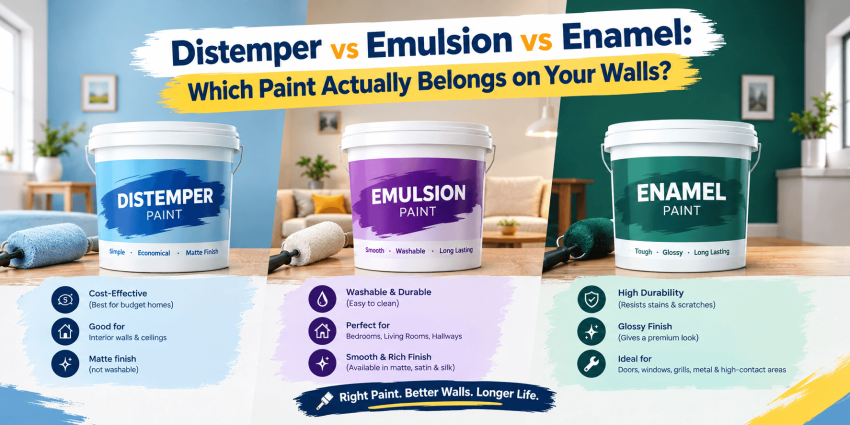
Three paints, three completely different jobs. Here’s how they compare on cost, durability and washability — and how to pick the right one for every surface in your home.
Throughout this guide, sand marks distemper, teal marks emulsion, and indigo marks enamel.
Walk into any paint shop and you’ll hear three words thrown around as if they’re interchangeable: distemper, emulsion and enamel. They are not. They’re built from different materials, they behave differently on the wall, and they cost very different amounts. Choosing the wrong one is the single most common — and most expensive — mistake homeowners make, because you usually only find out after the paint has started chalking, peeling or looking wrong.
This guide clears it up in plain language: what each paint actually is, how they compare where it counts, and exactly which one belongs on each surface in your home.
Short version: emulsion on your walls, enamel on your woodwork and metal, distemper only when budget or a rental makes it the sensible call. The detail below is where the money is saved.
The three, side by side
Here’s how they stack up on the things you’ll actually notice — before we get into why.
| Distemper | Emulsion | Enamel | |
|---|---|---|---|
| Base | Water-based (chalk / acrylic) | Water-based (acrylic) | Oil-based or water-based |
| Finish | Flat, matte, slightly chalky | Matte to high sheen — your choice | Satin to high gloss, hard |
| Best surface | Ceilings, low-traffic interior walls | Interior & exterior walls | Wood & metal (trim, not walls) |
| Washability | Poor to fair | Good — premium is scrubbable | Excellent, scrubbable |
| Typical lifespan | ~2–4 years | ~4–7+ years (more for premium) | Very long on prepped surfaces |
| Odour & drying | Low odour, fast | Low odour, fast | Strong (oil), slow to dry |
| Indicative cost | ₹ (lowest) | ₹₹–₹₹₹ | ₹₹–₹₹₹ |
Cost is relative and material-only; see the cost section for indicative ranges. Confirm exact figures for your home on a site visit.
Distemper
What is distemper?
Distemper is the traditional, budget-friendly wall paint — a water-based coating that’s been used on Indian homes for generations. It comes in two forms. Dry (cement) distemper is the cheapest: a chalk-and-binder powder mixed with water, with a soft matte look but a tendency to rub off on your hand or clothes. Acrylic distemper is the modern upgrade — smoother, mildly washable and noticeably more durable, while still costing a fraction of emulsion.
Where it wins
- The lowest cost per square foot of any option
- Low odour and quick drying — a room is usable fast
- Easy and cheap to refresh, which suits rentals
- Perfectly good for ceilings and low-traffic rooms
Where it falls short
- Chalks and fades far sooner than emulsion (~2–4 years)
- Poor washability — marks and scuffs are hard to remove
- Not weatherproof, so it’s unsuitable for exteriors
- Limited sheen and a flatter, more basic look
Best for: ceilings, rented flats, guest rooms, storerooms, and any project where budget is the deciding factor. Choose acrylic distemper over dry distemper wherever you can afford the small step up.Emulsion
What is emulsion?
Emulsion is the water-based, acrylic paint that has become the default for modern homes — and for good reason. It goes on smoothly, resists fading, wipes clean, and comes in a full ladder of quality, from economy lines through to premium ranges with stain resistance, anti-bacterial properties and a rich, even finish. There’s an emulsion for almost every wall, indoors and out.
The range is what makes emulsion flexible. Economy emulsions give you washability and durability at a sensible price. Mid and premium emulsions add scrubbability, deeper colours and a smoother sheen. And exterior emulsions — the weatherproof, anti-algal, UV-resistant kind — are engineered to hold up against sun and monsoon for years.
Where it wins
- Washable and durable — premium grades take real scrubbing
- Every finish available: matte, soft sheen, satin, high sheen
- Excellent colour choice and colour retention
- Works on interior and exterior walls with the right grade
- Low odour, low VOC options, comfortable to live with
Where it falls short
- Costs more than distemper, especially premium ranges
- Needs proper surface prep (putty, primer) to look its best
- Not the right film for wood and metal — that’s enamel’s job
Best for: the walls you live with every day — living rooms, bedrooms, kitchens, kids’ rooms — and all exterior walls (using a dedicated exterior grade). If you’re painting a home you own, emulsion is almost always the right call for the walls.
Enamel
What is enamel?
Enamel is the hard, glossy, wipe-clean finish built for surfaces that take a beating — and it’s designed for wood and metal, not walls. Traditional enamel is oil-based (solvent-based): extremely tough and washable, but with a strong smell, a slow dry time and a tendency to yellow over the years, especially in whites. Newer water-based enamels fix most of that — lower odour, faster drying, far less yellowing — while keeping the hard, protective finish.
Where it wins
- A hard, protective film that shrugs off knocks and handling
- Fully scrubbable — ideal for high-touch surfaces
- Bonds beautifully to wood and metal
- Rich gloss (or satin/matt enamel if you prefer less shine)
Where it falls short
- Oil-based versions have strong odour and slow drying
- Too glossy for large walls — it highlights every imperfection
- Less breathable than emulsion, so it’s wrong for plaster
Best for: doors, window frames, wooden furniture, railings, grilles, gates and metal pipes. Prefer a water-based enamel indoors to keep odour and yellowing down.
How they compare where it counts
Durability and lifespan
This is where the price gap earns its keep. Distemper is the shortest-lived — expect to redo it every few years as it chalks and dulls. Interior emulsion comfortably outlasts it, and premium grades longer still; exterior emulsion is built to survive years of weather. Enamel, on its proper surfaces, is the most durable film of all. Across the board, surface prep matters as much as the paint: even the best emulsion fails early over loose putty or a skipped primer.
Washability and cleaning
If you have children, a kitchen or busy hallways, this decides things. Dry distemper marks easily and can’t really be scrubbed; acrylic distemper handles a gentle wipe. Emulsion is genuinely washable, and premium emulsion takes repeated scrubbing without losing colour. Enamel is the most cleanable of all, which is exactly why it belongs on the surfaces that get touched most.
Look and finish
Distemper gives a flat, understated matte. Emulsion is the most versatile — from a soft chalky matte that hides wall imperfections to a luxurious sheen that makes colours glow. Enamel reads as a hard, reflective, almost lacquered surface, which looks superb on woodwork and jarring on a large wall.
Cost and value
As an indicative, material-only guide for two coats: distemper is the cheapest per square foot, economy emulsion sits a step above, premium emulsion higher again, and enamel is priced by the (usually smaller) wood and metal areas it covers. The real lesson isn’t the sticker price — it’s cost per year. A cheap paint you redo twice as often rarely saves money once you add labour back in.
A note on pricing: figures here are indicative ranges only and exclude labour. Actual cost depends on brand, grade, finish, city, surface condition and coats. Always confirm on a site inspection before budgeting.
So which should you choose? A surface-by-surface guide
Match the paint to the job, not the other way round. Here’s the shortcut for the decisions people ask us about most.
Two rules cover most homes: never put distemper or enamel on exterior walls (only exterior emulsion survives out there), and never use wall paint on wood or metal (it won’t hold up — that’s enamel’s territory). For damp walls, no paint alone fixes the problem; treat the source of moisture first, then repaint.
The mistake that costs the most
Almost every expensive repaint we’re called in to fix comes down to one of three errors: using distemper on walls a family will live with for years and watching it chalk within a season or two; brushing glossy enamel across large plaster walls where it looks harsh and traps moisture; or spending on premium paint but skipping surface prep, so it fails early anyway. The paint is rarely the villain — the pairing is. Get the surface and the paint matched correctly and even a mid-range choice will look good and last.
Frequently asked questions
Which is better, distemper or emulsion?
Emulsion is the better long-term choice for walls you live with: it’s washable, lasts 4–7+ years and comes in every finish. Distemper is cheaper but chalky and short-lived, so it suits ceilings, rentals and tight budgets rather than main living walls.
Can I use emulsion on doors and windows instead of enamel?
It’s not recommended. Wood and metal flex, get touched constantly and need a hard, scrubbable film. Enamel gives that; standard wall emulsion will scuff and wear quickly on trim. Use enamel — ideally a water-based one indoors — on doors, windows, grilles and railings.
Is distemper waterproof? Can it be used on outside walls?
No. Distemper isn’t waterproof and isn’t built for weather, UV or algae. Exterior walls need a dedicated exterior emulsion. Distemper outdoors will fade, chalk and wash off within a season or two.
How long does each type of paint last?
As a rough guide: distemper around 2–4 years, interior emulsion 4–7+ years (premium longer), exterior emulsion 5–10 years, and enamel on well-prepped wood or metal is very long-lived. Surface prep and quality make a big difference to these numbers.
Which paint is best for a rented flat?
Acrylic distemper is usually the smart choice for a rental — it refreshes walls cheaply and is easy to redo. If the landlord wants a lasting finish, an economy emulsion is a modest step up.
Is enamel paint a good choice for interior walls?
Generally no. On large plastered walls enamel looks too glossy, highlights imperfections and is less breathable than emulsion. Keep enamel for wood and metal, and use emulsion on the walls themselves.